Miru 2025 Year in Review: From Side Project to 500+ Teams
An honest look back at Miru's 2025. The milestones, the mistakes, and what we learned building an open-source product company from India.
 Vipul A M · · 3 min read
The milestones
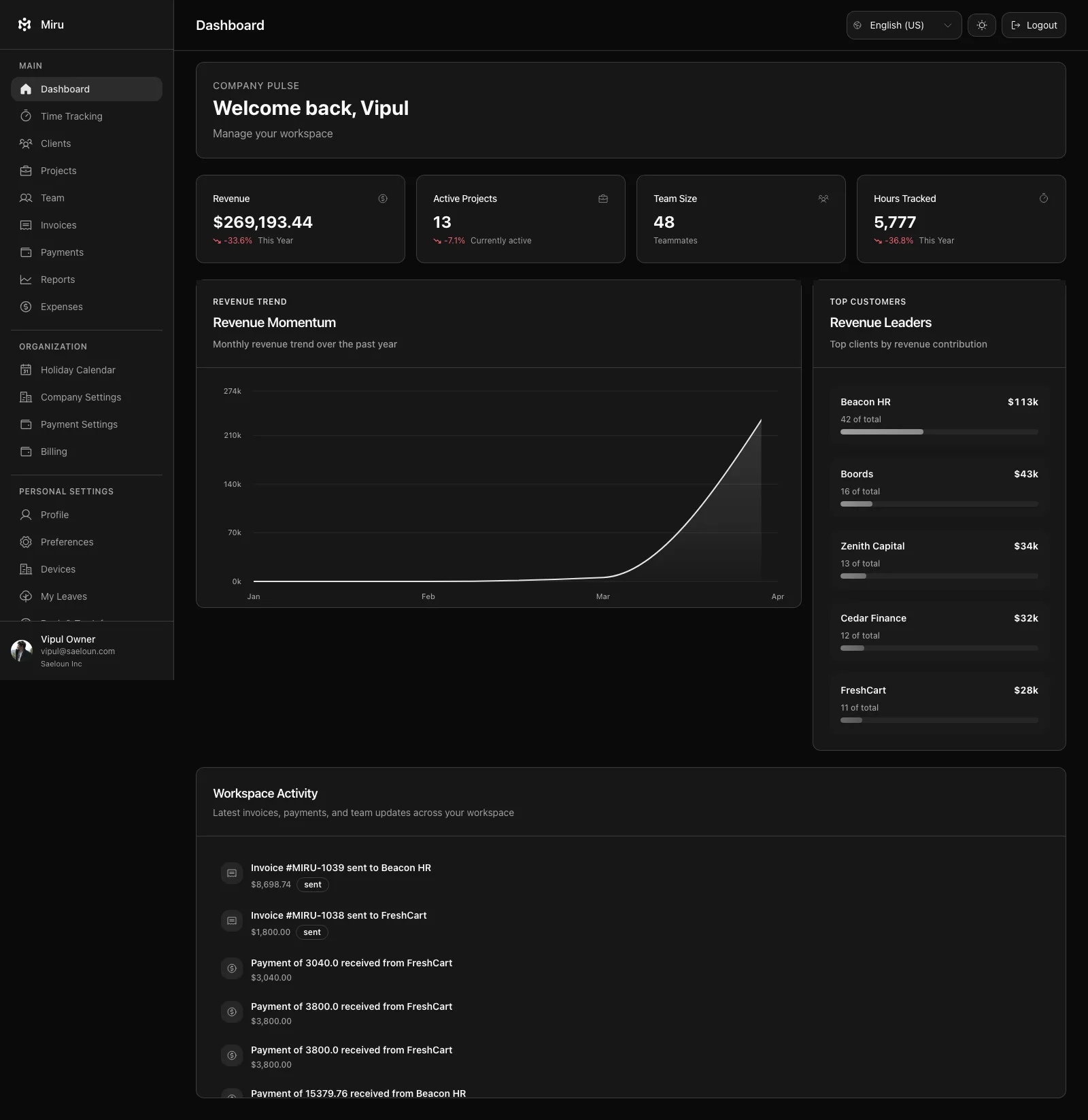
v1.0 shipped in March. We’d been running Miru internally for over a year, but calling something “1.0” changes the psychology. It means you’re saying: this is ready. Use it for real work. Send real invoices with it. We sweated over that label. Then we shipped it and nobody cared about the version number. They cared about whether it worked. It did.
First 100 users by June. Slow by startup standards. Fine by ours. These weren’t people who clicked a Product Hunt button and never came back. They were consultants, freelancers, and small agencies who set up their workspace, imported their clients, and started tracking time. Real usage. Real invoices going out. That matters more than a signup counter.
Expense management shipped in August. The most-requested feature from day one. Receipt uploads, approval workflows, reimbursement tracking. We built it because our own team needed it. Turns out, so did everyone else. Usage doubled in the month after launch.
The CLI launched in October. For developers who live in the terminal and hate browser tabs. miru track, miru log, miru status. It started as a weekend hack by one of our engineers. Fourteen weeks later it was a full-featured command line tool with its own documentation site. Sometimes the best features come from scratching your own itch at 2 AM on a Saturday.
Open source from day one, but 255 GitHub stars by December. Stars are a vanity metric. I know that. But they represent something real: 255 developers who looked at our code and thought “this is worth bookmarking.” Sixty-one of them contributed code. Ninety forked the repo to run their own instance. For a tool built by a consulting shop in Pune, that’s not nothing.
What we got wrong
We underestimated the invoicing workflow. Time tracking was solid from the start. Invoicing felt bolted on. Users told us, repeatedly. It took us until Q3 to properly redesign the invoice creation flow, and we should have done it in Q1.
Documentation was an afterthought. For the first six months, our docs were README files and inline comments. Developers could figure it out. Non-developers couldn’t. We lost users who would have stayed if we’d written a proper getting-started guide earlier. We fixed this, but later than we should have.
We tried to be everything. There was a two-month stretch where we were building calendar integration, project templates, and a mobile app simultaneously. None shipped. All three got shelved. The lesson: do fewer things. Do them well. Ship them. Then move on.
What we learned
$1/user/month is the right price. We debated this endlessly. Every advisor said charge more. Every pricing blog said we were leaving money on the table. But the $1 price point does something magical: it removes the “do we really need this?” conversation. Teams sign up without procurement approval. Freelancers don’t think twice. The low price creates volume, and the volume creates a sustainable business. We’re not going to change it.
Open source is a moat, not a liability. People said open-sourcing a SaaS product was suicide. Competitors would fork it. Customers would self-host and never pay. Neither happened at scale. What did happen: developers trusted us. Security-conscious teams could audit the code. Contributors improved the product for free. Open source built the credibility that no marketing budget could buy.
Consulting and product can coexist. The conventional wisdom says pick one. We picked both. Consulting revenue funds product development. The product attracts developers who become consulting leads. They feed each other. It’s not a VC-backed rocket ship. It’s a sustainable business that grows every month.
What’s next
2026 is about depth, not breadth. Recurring invoices. Multi-currency. A mobile app (for real this time). Better reporting. Webhooks and integrations. We’re not chasing new markets. We’re making Miru indispensable for the teams already using it.
Check the roadmap for specifics. Or just watch the changelog — we ship weekly.
Thanks to every team that trusted Miru with their billing in 2025. We don’t take that lightly. Your time data and your invoice history are your business. We’re just the tool. We intend to be the best one.
Here’s to 2026.
Hard Stop
Use it in production and tell us exactly where the workflow still fights you.
Start with Miru or read the docs.
Vipul A M
Co-founder at Saeloun. Building Miru. Rails contributor. Shipping from Pune, India.
Read next
From Consulting Agency to Product Company: The Miru Origin Story
We built Miru because we were a consulting company that couldn't find a decent time tracker. Here's the honest story of how it happened.
Pricing update: $1 per member, from the first member
Miru's cloud pricing is changing. No more free tier — every member is $1/month from day one. Self-hosting stays free. Here's the reasoning.
How We Use gbrain to Build Miru
How Saeloun uses gbrain, gstack, Codex, Claude, MCP, and repo signals to build Miru with memory, safer AI automation, and proof before claims.
Put it to work
Run one cleaner billing cycle in Miru.
If this article is about tracking time, billing clients, comparing tools, or automating work, Miru is the product version of that idea. Start for $1/member, invite the team, and send the next invoice from tracked work.
What you get
- Time tracking, invoices, expenses, and payments in one place.
- $1 per member per month. Free if you self-host.
- Open source, with CLI, API, MCP, and self-hosting paths.
The article is the argument. Miru is the workflow.
Track the work, approve the hours, send the invoice, and get paid without bolting together three separate tools.